
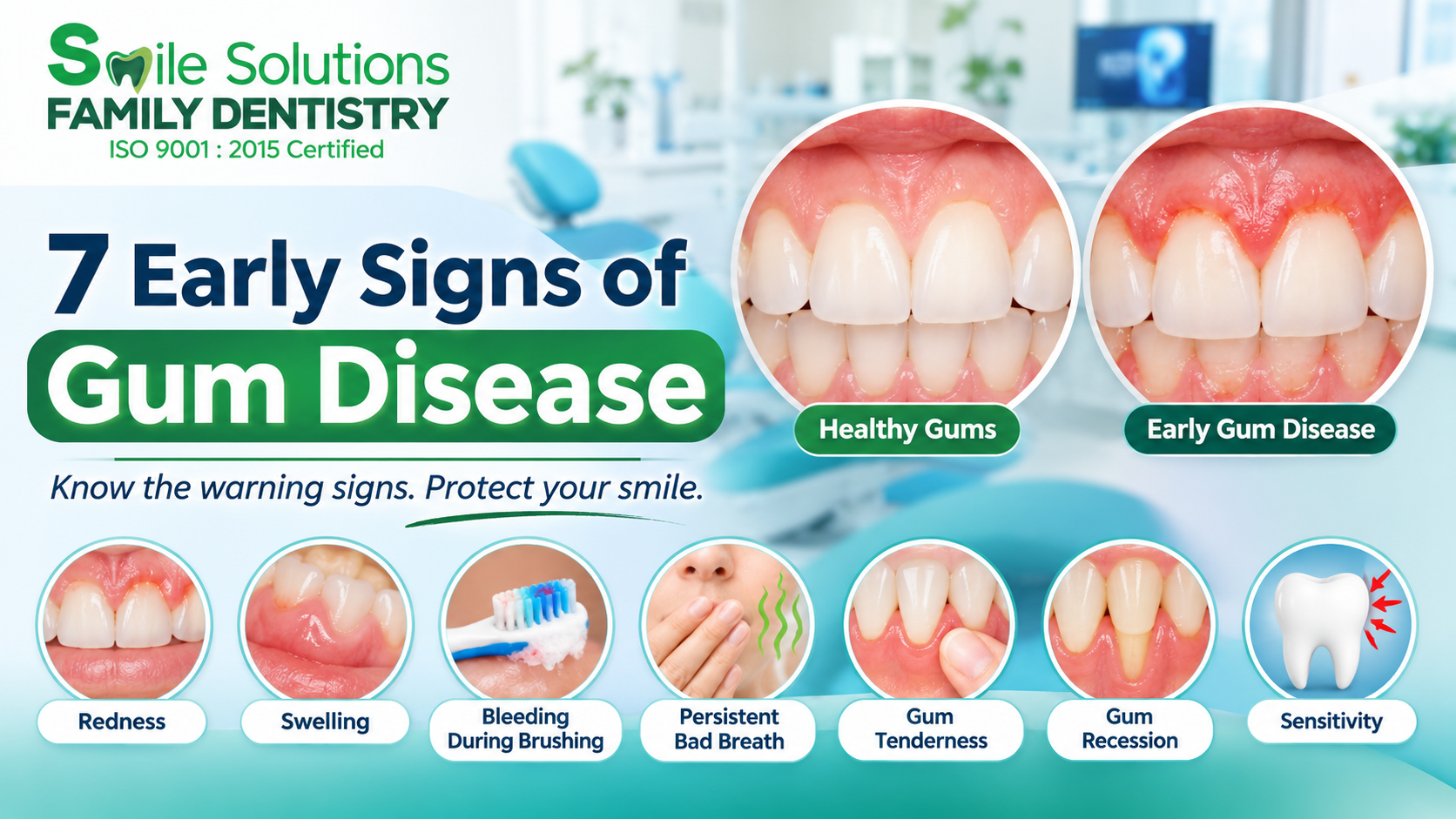
Bleeding gums, bad breath, swelling? Learn the 7 early signs of gum disease and book a checkup with Dr M. Srikanth in Chrompet, Chennai.
By Dr. M. Srikanth, BDS, MDS (Prosthodontics) · Smile Solutions Family Dentistry, Chrompet & Thoraipakkam, Chennai · Published 02 November 2026
The 7 early signs of gum disease are bleeding gums, persistent bad breath, red or swollen gums, receding gums, loose or shifting teeth, a change in your bite, and pus or pain along the gumline. Gum disease usually begins painlessly, so bleeding while brushing is often the first and only warning. Caught early, it is fully reversible. Left alone, it destroys the bone that holds your teeth.
This guide is reviewed by Dr M. Srikanth, BDS, MDS (Prosthodontics), a Tamil Nadu State Dental Council registered dentist (Reg. No. 5487) with 25+ years of experience at Smile Solutions Family Dentistry, Chennai.
Gum disease (periodontal disease) is a bacterial infection of the tissue around your teeth. The World Health Organization estimates that close to a billion people live with severe gum disease worldwide (WHO oral health fact sheet). Most never feel pain until the damage is advanced.
It happens in two broad stages:
Many people ignore a little blood in the sink for months. Here are the signs worth acting on.
Healthy gums do not bleed. If you see pink in the sink, on your toothbrush or on floss, the gum tissue is inflamed by plaque bacteria. This is the most common early sign of gingivitis and the one people dismiss most often as "brushing too hard".
What to do: brush twice a day gently with a soft brush, clean between teeth daily, and book a check-up if bleeding lasts more than a week. See our guide to correct brushing techniques.
Breath that stays unpleasant after brushing, mouthwash or mints can point to bacteria hiding in gum pockets. These bacteria release sulphur compounds that you cannot brush away from the surface of the tongue alone.
What to do: brush your tongue, clean between teeth, and have your gums measured by a dentist if the odour keeps returning.
Healthy gums are firm, pale pink and fit snugly around each tooth. Gums that look dark red, puffy, shiny or feel tender to touch are signalling active infection. Swelling often shows first between the teeth.
What to do: do not wait for pain. Early gingivitis is the cheapest and easiest stage to treat.
When gums pull back, the tooth looks longer, and the root surface is exposed. You may notice sensitivity to hot, cold or sweet food. Recession can come from gum disease, aggressive brushing or a misaligned bite, so the cause needs a professional diagnosis.
What to do: have a dentist check the cause. Exposed roots decay faster and can be treated early to stop further loss.
Adult teeth should not move. Looseness or new gaps appearing between teeth means the bone and ligament holding them are being lost, a hallmark of periodontitis.
What to do: see a dentist promptly. Treatment can stabilise the teeth. If a tooth cannot be saved, options such as dental implants, bridges or dentures can restore function and appearance.
If your bite feels different, your dentures no longer fit, or teeth seem to be drifting, supporting bone may have changed. This sign is easy to blame on age, but it deserves an examination.
What to do: note when the change started and mention it at your visit. A bite assessment by a prosthodontist helps plan correction.
Pus between teeth and gums, a gum boil, or pain when chewing signals an abscess, an advanced infection that needs prompt treatment. It will not heal on its own.
What to do: book the earliest appointment. If you also have facial swelling or fever, seek urgent care the same day.
Feature
|
|
||
|
Gingivitis (early) |
Periodontitis (advanced) |
|
|
Gums |
Red, puffy, bleed easily |
Receding, pockets, pus possible |
|
Bone loss |
None |
Present and progressive |
|
Teeth |
Firm |
May loosen or shift |
|
Reversible? |
Yes, fully |
Controllable, bone loss is not reversed on its own |
|
Typical care |
Professional cleaning, better home care |
Deep cleaning, advanced gum therapy, regular maintenance |
Plaque is the root cause. When it hardens into tartar, only a dentist can remove it. These factors raise your risk:
Gum disease and diabetes affect each other, so people with diabetes should have their gums checked at least twice a year.
Treatment depends on the stage. Your dentist will measure gum pocket depth and may take an X-ray to check bone levels.
Smile Solutions offers gum assessment alongside prosthodontic and cosmetic care, so gum health and tooth replacement can be planned together.
Dr M. Srikanth, BDS, MDS (Prosthodontics) is a Prosthodontist, Implantologist and Cosmetic Dentist at Smile Solutions Family Dentistry, Chennai, with 25+ years of experience. The Tamil Nadu State Dental Council verifies his registration.
Credential
|
|
|
|
Details |
|
|
Registration number |
Reg. No. 5487 |
|
Year of registration |
2001 |
|
Licensing council |
Tamil Nadu State Dental Council (State Council Verified) |
|
MDS, Prosthodontics |
Sri Balaji Dental College, Chennai, 2007 |
|
BDS, Bachelor of Dental Surgery |
Saveetha Dental College and Hospital, Chennai, 2001 |
|
Areas of specialization |
Prosthodontics, Dental Implantology, Cosmetic Dentistry, Periodontology |
|
Professional memberships (4) |
Academy of Oral Implantology (AOI), Indian Academy of Laser Dentistry, Indian Dental Association (IDA), Indian Prosthodontic Society (IPS) |
If gum disease has already cost you a tooth, his prosthodontic training means he can plan gum treatment and tooth replacement as one continuous care journey.
Bleeding gums during brushing or flossing is usually the first sign. Redness, swelling and bad breath often follow.
Gingivitis, the early stage, can be fully reversed with professional cleaning and good home care. Periodontitis can be controlled and stabilised, but lost bone does not regrow on its own.
No. Healthy gums do not bleed. Occasional bleeding after starting to floss may settle within a week, but bleeding that continues needs a dental check.
Yes. Bacteria in inflamed gum pockets release foul-smelling compounds, so bad breath that returns soon after brushing is a common gum disease sign.
Usually not in the early stages, which is why it is often missed. Pain, pus or loose teeth generally mean the disease is advanced.
Yes. Untreated periodontitis is a leading cause of adult tooth loss because it destroys the bone supporting the teeth.
Every six months for most adults. People with diabetes, smokers and those with a history of gum disease may need visits every three to four months.
Book an examination with a dentist who will measure gum pockets, review your X-rays and advise cleaning or deep gum therapy. Smile Solutions Family Dentistry has branches in Chrompet and Thoraipakkam.
Do not wait for pain. A short examination can catch gum disease while it is still reversible. Consult Dr M. Srikanth at Smile Solutions Family Dentistry.
Chrompet branch: No 44, Near Sudar Hospital, Ramachandra Street, Nehru Nagar, Chrompet, Chennai, Tamil Nadu 600044
Thoraipakkam branch: 3/4, 200 Feet Radial Rd, Vinayaganagar, MCN Nagar Extension, Thoraipakkam, Chennai, Tamil Nadu 600097
Call: +91-9384877610 or 044-43575349
Book online: Book an appointment
Website: smilesolutions.in
Medical disclaimer: This article is for general education and does not replace a personal examination. Reviewed by Dr M. Srikanth, BDS, MDS (Prosthodontics), Reg. No. 5487, Tamil Nadu State Dental Council