Learn what an RVG radiograph is, what it detects, its benefits and safety, and how RVG differs from an OPG dental X-ray. Smile Solutions, Chromepet.
Reviewed by Dr. M. Srikanth, BDS, MDS | Smile Solutions Family Dentistry, Chromepet | Last reviewed: [09-10-2026]
An RVG radiograph is a digital dental X-ray that gives your dentist a close, clear picture of one tooth or a small group of teeth, including the roots and the bone around them. If someone has told you “You need an RVG" for a toothache, a root canal or a swelling near the gum, this page explains what it is, what it shows, how it differs from an OPG, and what happens when you sit in the chair. No jargon and no scare stories, just what your dentist would tell you if you had ten spare minutes.
RVG stands for RadioVisioGraphy. It's the dental X-ray most people get when they walk in with a sore tooth.
Instead of the old film you may remember from years ago, a small digital sensor, about the size of a postage stamp, is placed inside your mouth next to the tooth being checked. A quick burst from the X-ray machine, and the image appears on the screen within seconds. You can usually see it too, and a good dentist will point out exactly what they're looking at.
Your dentist doesn't read the image alone. They look at it together with what you've told them, what they see in your mouth, and how the tooth responds when they tap or press it. The X-ray is one piece of the puzzle.
A lot can't be seen just by looking into your mouth. An RVG shows what's happening below the surface. What it picks up depends on the area being imaged and how the picture is taken, so your dentist chooses the angle and view to suit your problem.
The cavities that catch people out are often the ones between two teeth, where you can't see them and a toothbrush can't reach. They may not hurt until they're quite deep. An RVG can show them early, when a simple filling may be all you need.
The part of the tooth you see is only about half of it. The roots sit in the jaw bone, and an RVG shows their length, shape and the health of the bone holding them.
If you've had a throbbing pain that wakes you at night, or a pimple-like bump on the gum, there may be an infection at the tip of the root. An RVG can show changes in that area, which helps your dentist work out what's going on.
Before a root canal, the X-ray shows the shape of the roots. During treatment, it helps check progress. After treatment, a later image shows how the area is healing.
After a fall or a knock to the mouth, an RVG can help check whether a tooth or root has been affected. It can also show bone levels around teeth when gum problems are suspected.
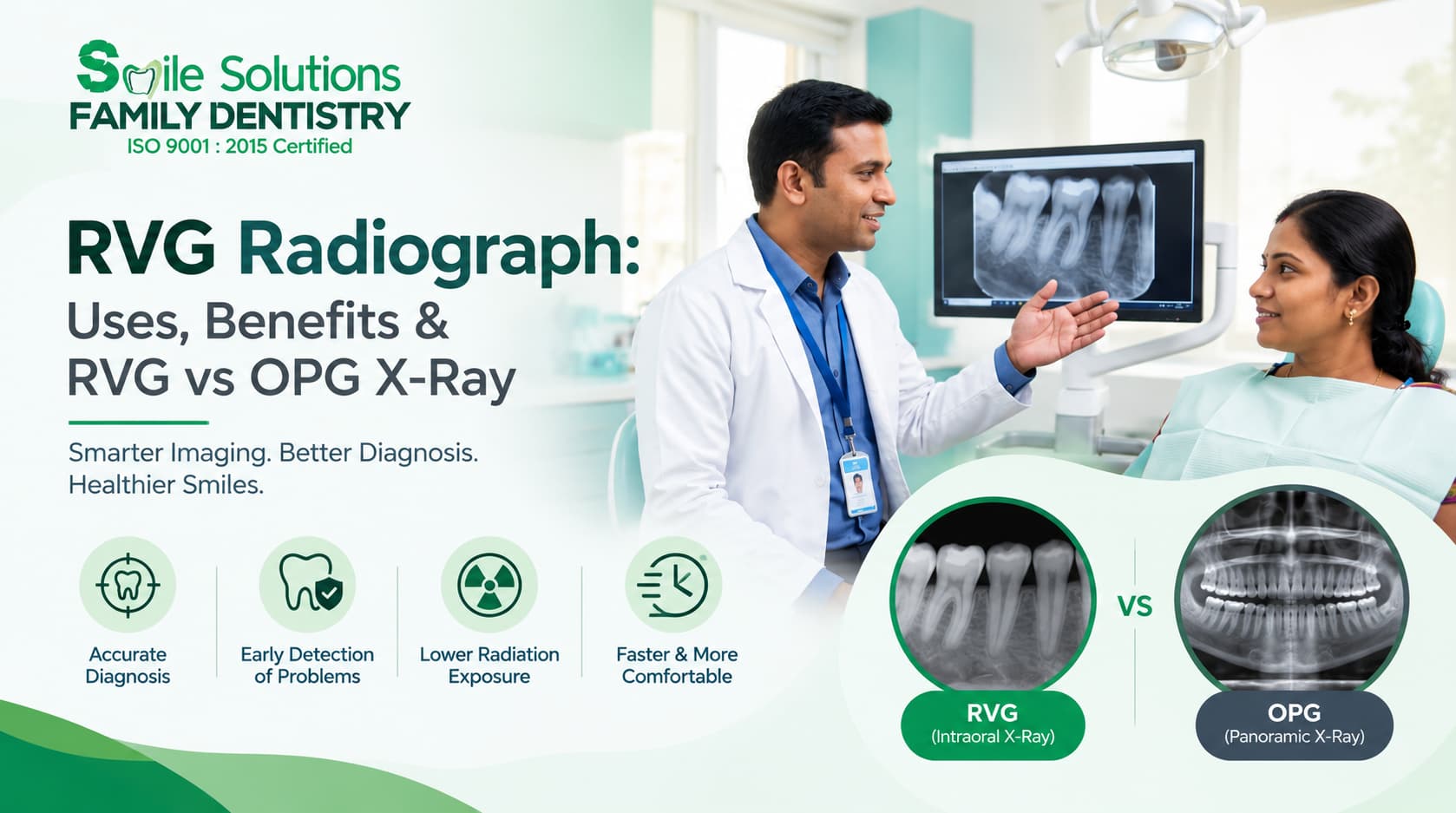
Plenty of people get confused here, because both are dental X-rays. Think of it like this: an RVG is a zoom lens, and an OPG is a wide-angle shot.
|
RVG radiograph |
OPG X-ray |
|
|
What you see |
Selected teeth and nearby structures |
Both jaws and all teeth in one wide image |
|
How it's taken |
Small sensor inside your mouth |
Machine rotates around your head while you stand or sit still |
|
Best for |
Close detail of one area |
Overview of the whole mouth and jaws |
|
Common uses |
Decay, roots, root canal checks |
Wisdom teeth, impacted teeth, jaw overview, treatment planning |
Neither one is "better." If one tooth is troubling you, your dentist will likely start with an RVG. If you're being assessed for wisdom tooth removal or a larger treatment plan, an OPG may make more sense. Sometimes you'll need both. Your dentist chooses based on your problem, so if you've been asked for one and not the other, that's usually why.
This is the question we hear most, and it's a fair one. Dental X-rays use a small amount of radiation, so dentists are careful about when to take them. The rule is simple: an X-ray should only be taken when what it tells your dentist is worth it.
In practice, that means:
If you're worried, ask. A good dentist will always explain why they want an X-ray and listen to your concerns.
It's a short, simple visit. Here's how it usually goes:
Does it hurt? The X-ray itself doesn't. The sensor can feel a little awkward, especially at the back of the mouth or if the tooth is already sore. Tell your dentist if it's uncomfortable and they can adjust. There's nothing you need to do beforehand. Most people are in and out quickly, though total time depends on how many images are needed.
Work or college all day? We're open until 9:30 PM from Monday to Saturday, so you can come after work without taking leave for a toothache. On Sundays we're open from 9:15 AM to 1:30 PM.
The cost depends on how many images your dentist needs and what you're being checked for, so it varies between clinics. We'd rather give you the right number for your situation than a figure that doesn't apply.
You can get a dental assessment, and an RVG if your dentist advises one, at Smile Solutions Family Dentistry in Chromepet, Chennai. If you're coming from Pallavaram, Tambaram, Hasthinapuram or nearby, call or WhatsApp us on 9384877610 to check timings or ask what to expect before you come.
Monday to Saturday: 9:15 AM to 9:30 PM
Sunday: 9:15 AM to 1:30 PM
Have questions about a dental X-ray? Call 9384877610 or WhatsApp us and ask. No pressure, just a straight answer.
It's a digital dental X-ray taken with a small sensor placed inside the mouth. It gives your dentist a close-up image of specific teeth, their roots and the surrounding bone, shown on a screen within seconds.
Dentists use it to check for decay between teeth, look at roots and bone, investigate pain or suspected infection, and plan and follow up root canal treatment. It's also used after dental injuries.
It can show cavities between teeth, changes around the root tip, bone levels around teeth, and the shape of the roots. What it shows depends on the area imaged and the angle, so your dentist picks the view that suits your problem.
No, the X-ray itself isn't painful. Holding the sensor in your mouth can feel awkward for a few seconds, and more so if the tooth is already sore. Let your dentist know and they can reposition it.
RVG is a digital method, so the image appears quickly and can be zoomed and stored. Whether it's the right choice depends on what your dentist needs to see. Sometimes a different X-ray, like an OPG, answers the question better.
An RVG gives a close-up of selected teeth and nearby bone. An OPG gives one wide image of both jaws and all the teeth. Your dentist chooses one, or both, depending on your problem.
Dental X-rays use a small amount of radiation, and dentists only take them when needed. For children, the dentist decides based on the child's symptoms and needs. If you're unsure, ask why the X-ray is being recommended.
Please tell your dentist if you're pregnant or might be. They'll decide whether the X-ray is needed now or can wait, and will take extra precautions if it can't. Don't skip telling them, even if the pain feels minor.
The image itself is captured in seconds. Overall time depends on how easy it is to position the sensor and how many images are needed. Most people find it a short part of the visit.
It varies by clinic and by how many images are needed. For an accurate figure, call or WhatsApp Smile Solutions Family Dentistry on 9384877610 and we'll tell you what applies to you.
If you've got a toothache, a swelling, or a dentist has advised an X-ray, don't sit on it. Tooth problems rarely sort themselves out, and they're usually simpler to treat the earlier they're caught.
Come in and Dr. Srikanth will look at the problem first, then decide whether you need an RVG, an OPG, or nothing at all. You'll know why before anything is done.