Full mouth dental implants explained by Dr. M. Srikanth, Prosthodontist in Chrompet, Chennai: procedure steps, benefits, recovery timeline, cost and FAQs.
By Dr. M. Srikanth, BDS, MDS (Prosthodontics), Prosthodontist and Implantologist, Smile Solutions Family Dentistry, Chrompet, Chennai
Published: 26 November 2026 | Last updated: 26 November 2026
Short answer: Full mouth dental implants replace all the teeth in your upper jaw, lower jaw or both, using a small number of titanium implants that hold fixed, non-removable teeth. The treatment is meant for adults in Chennai who have lost most or all of their teeth, or whose remaining teeth cannot be saved, and who have enough healthy jawbone (or can have it built up). At Smile Solutions in Chrompet, Dr. M. Srikanth, a prosthodontist with 25+ years of experience, plans each case around your bone, bite and budget.
Key takeaways:
If you are tired of loose dentures, failing teeth or difficulty chewing, this guide explains how the treatment works, what recovery feels like, what it costs in Chennai and what to ask before you commit.
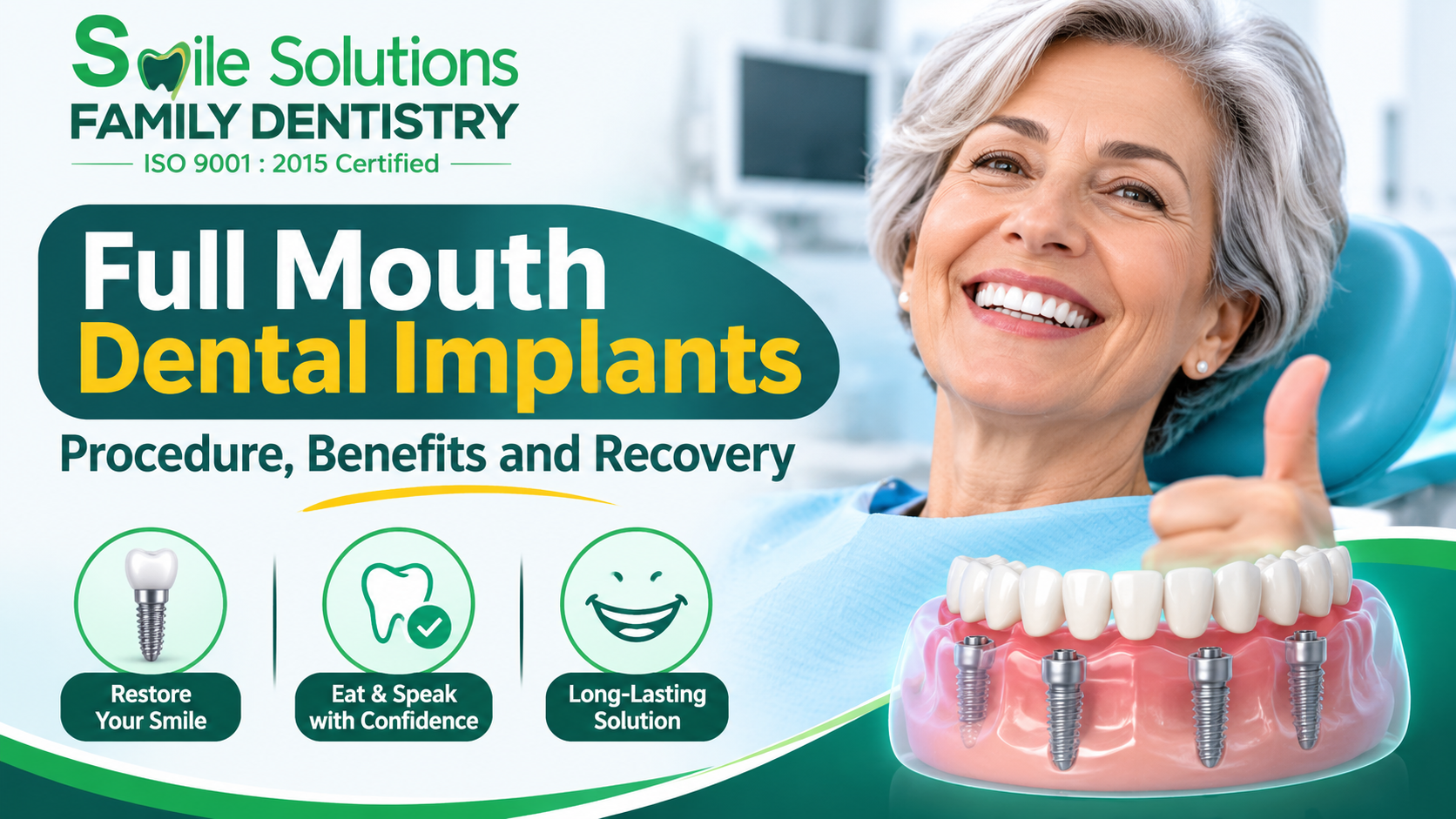
Full mouth dental implants are a way of replacing a whole arch of missing teeth with titanium posts placed in the jawbone and a custom-made fixed bridge or denture attached on top. The posts act as artificial tooth roots. The American Dental Association describes implants as posts surgically placed in the upper or lower jaw that anchor replacement teeth, made of titanium and other body-compatible materials. The treatment is also called full arch rehabilitation or full mouth rehabilitation with implants.
The approach differs from replacing teeth one at a time. A full arch is usually supported by a limited number of strategically placed implants, which keeps surgery shorter and often reduces cost compared with one implant per tooth.
You may be a good candidate if most of your teeth are missing or cannot be saved, you have enough jawbone (or can have it grafted) and you are in reasonable general health. Specifically, you may be suitable if you:
Health and habits matter. The Mayo Clinic lists insufficient jawbone, conditions that affect bone healing, unhealthy mouth tissues and tobacco use among the factors that can cause complications or implant failure, and the ADA notes that chronic conditions such as diabetes may interfere with healing and that tobacco slows it. A scan and clinical examination are essential before anyone can confirm candidacy. As a prosthodontist and implantologist, Dr. Srikanth assesses bone volume, gum health and bite before recommending a plan, and treats gum disease or other problems first.
The procedure runs in seven stages, from a scan-based consultation to the final fixed bridge, and typically takes about 3 to 6 months in total because bone needs time to bond with the implants. Here is the sequence at Smile Solutions:
This matches the general pattern described by the Mayo Clinic: surgery is usually done in stages, the jawbone grows into the implant in a process called osseointegration that can take several months, and the whole process can take many months from start to finish. The ADA adds that some patients can have the implant and replacement teeth placed in one visit, and that a temporary crown, bridge or denture may be used while permanent teeth are made.
The main options are All-on-4, All-on-6, an implant-supported fixed bridge and an implant-retained overdenture. They differ in the number of implants and in whether the final teeth are fixed or removable.
|
Option |
What it involves |
Best suited to |
|
All-on-4 |
4 implants per arch, rear ones tilted to use available bone |
Patients with limited back-jaw bone who want to avoid grafting |
|
All-on-6 |
6 implants per arch for extra support |
Patients with good bone who want a more distributed bite load |
|
Implant-supported fixed bridge |
Several implants carrying a fixed bridge |
Patients needing precise, tailored positioning |
|
Implant-retained overdenture |
Implants hold a removable denture that snaps on |
Patients wanting a more affordable option that is easier to clean |
The right choice depends on your bone, bite, health and budget, which is why a personal assessment comes first.
The main benefits are stable teeth that stay fixed, better chewing, a natural appearance and a long-term solution. The Mayo Clinic notes that implants provide solid support for new teeth, will not slip or make noise, will not cause bone damage the way dentures or bridgework can, and are made of materials that cannot decay. The ADA calls them an excellent long-term option for restoring your smile.
For most people who can have surgery, fixed implants feel more stable than conventional dentures, but dentures cost less upfront and need no surgery. The comparison below shows the main differences.
|
Factor |
Full mouth implants |
Conventional dentures |
|
Fit and stability |
Fixed to implants; no slipping |
Rest on gums; can loosen over time |
|
Eating |
Closer to natural chewing |
May limit some foods |
|
Surgery |
Yes, with healing time |
No |
|
Treatment time |
About 3 to 6 months |
Usually shorter |
|
Upfront cost |
Higher |
Lower |
|
Daily care |
Brush and clean around implants; regular reviews |
Remove and clean daily; periodic relining |
If you are unsure, an implant-retained overdenture can be a middle path. Dr. Srikanth will explain which option suits your bone, health and budget.
Most people feel much better within 1 to 2 weeks, follow a soft diet for several weeks, and have fully healed bone after about 3 to 6 months. Recovery varies by person and by whether grafting or extractions were done. A typical pattern looks like this:
|
Stage |
What usually happens |
|
Day 1 to 3 |
Swelling, mild bleeding and soreness; rest, cold compresses and prescribed medicines |
|
Week 1 to 2 |
Swelling and discomfort ease; stitches are reviewed; soft foods only |
|
Week 2 to 6 |
Gums heal; most people return to normal routines; keep to soft foods |
|
Month 3 to 6 |
Implants fuse with bone; the final bridge is made and fitted |
|
After fitting |
Regular cleaning, hygiene reviews and bite checks |
These timelines are general; Dr. Srikanth will give you a schedule specific to your case.
As with any surgery, risks include infection, implant failure, nerve irritation and gum inflammation around implants (peri-implantitis). The Mayo Clinic also lists damage to nearby structures and, for upper-jaw implants, sinus problems, and says these problems are usually minor and easily treated. Careful planning, good oral hygiene and not smoking lower the risks. Call the clinic promptly if you notice heavy bleeding, fever, worsening pain or a loose implant.
When comparing quotes, ask:
A lower quote that leaves out these items can cost more later.
In our clinic, every full mouth implant case starts with planning the final teeth first and then placing the implants to support them. This prosthodontic-first approach is the main reason we involve a prosthodontist from the first visit. At the planning stage, our team checks:
Our patients most often tell us they want three things: teeth that do not move, the ability to eat normally again and a clear, written cost before they start. We build each plan around those priorities.
Dr. M. Srikanth is a dentist, prosthodontist, implantologist and cosmetic/aesthetic dentist in Chrompet, Chennai, with over 25 years of experience. He is a state council verified practitioner.
|
Registration and licence |
Details |
|
Registration number |
Reg. No. 5487 |
|
Year of registration |
2001 |
|
Licensing council |
Tamil Nadu State Dental Council |
|
Verification status |
State Council Verified |
|
Academic qualification |
Institution |
Year |
|
MDS, Prosthodontics |
Sri Balaji Dental College, Chennai |
2007 |
|
BDS, Bachelor of Dental Surgery |
Saveetha Dental College & Hospital, Chennai |
2001 |
Areas of specialization: Prosthodontics, Dental Implantology, Cosmetic Dentistry, Periodontology
Professional memberships:
Dr. Poornima Srikanth is a cosmetic/aesthetic dentist, dental surgeon and oral pathologist in Chrompet, Chennai, with 18 years of experience.
In healthcare, 5-star patient reviews are a valuable form of feedback. They help prospective patients choose where to seek care, and often highlight clinical expertise, compassion, prompt service and good outcomes.
Here is what recent patients of Smile Solutions have said:
★★★★★ “Service is good” — Suriyaprakash R
★★★★★ “Good” — Rama Lakshmi
★★★★★ “Very good treatment done by Dr Sriram Dr. Sai Lakshmi and Sharmila” — Balasubramanian Kannan
★★★★★ “I had multiple dental fillings, including some deep cavities, and Dr. Purina handled the entire procedure exceptionally well. She was very gentle, patient, and professional throughout the treatment, making the experience smooth and comfortable. I truly appreciate her care and expertise. Thank you so much, Dr. Purina!” — Kausa Chan
★★★★★ “Doctor and staff are very kind The clinic is neat and hygiene my tooth problem is solved” — Bhanumathi Gunasekaran
★★★★★ “Dr.Sailakshmi They have done wonderful job Asst. Sharmila” — Venkatakrishnan Ramadeva
Frequently Asked Questions About Full Mouth Dental Implants
The whole process usually takes about 3 to 6 months from surgery to the final bridge, because the implants need time to fuse with the bone. Many patients receive a fixed temporary bridge in the meantime.
Surgery is done under local anaesthesia, with sedation available, so you should not feel pain during it. Soreness and swelling afterwards are usually managed with prescribed medicines.
Most people feel much better within 1 to 2 weeks, though a soft diet continues for several weeks and full healing of the bone takes a few months.
Often 4 to 6 implants per arch, depending on bone quality, bite forces and the type of bridge. Your scan determines the exact number.
In suitable cases a fixed temporary bridge can be placed soon after surgery, and the ADA notes that some patients have the implant and replacement teeth placed in one visit. Whether this is possible depends on how stable the implants are.
The ADA describes implants as an excellent long-term option, but no one can promise a fixed lifespan. How long they last depends on your oral hygiene, regular check-ups, general health and whether you smoke. The bridge on top may need maintenance or replacement over time.
Implants are fixed, feel more stable and do not cause bone damage the way dentures can, according to the Mayo Clinic, while conventional dentures are removable and can loosen over time. Dentures cost less upfront, so the right choice depends on your needs and budget.
People with uncontrolled diabetes, active gum infection, heavy smoking habits or other conditions that affect healing may need treatment first or an alternative option. A consultation will confirm what is safe for you.
The cost depends on the number of implants, the brand, any grafting or extractions and the type of final teeth. After a scan and examination, Smile Solutions provides a written estimate so you know the full cost before you start.
Smile Solutions Family Dentistry offers full mouth dental implant planning and treatment with Dr. M. Srikanth at its Chrompet and Thoraipakkam branches.
To find out whether full mouth dental implants are right for you, book an appointment at Smile Solutions or call +91-9384877610 or 044-43575349.
Chrompet branch: No 44, Near Sudar Hospital, Ramachandra Street, Nehru Nagar, Chrompet, Chennai, Tamil Nadu 600044
Thoraipakkam branch: 3/4, 200 Feet Radial Rd, Vinayaganagar, MCN Nagar Extension, Thoraipakkam, Chennai, Tamil Nadu 600097